




3 leadership habits to stop undermining psychological and psychosocial safety

How everyday leadership behaviour can create threat, even when our intentions are good.
The psychological safety paradox: You tell your team, “My door is always open.” You encourage people to speak up, share ideas and tell you when something isn’t working. But then someone challenges your thinking and you become defensive. Someone makes a mistake and the first question is, “How did this happen?” Priorities change, but nobody explains why. People are told they are empowered, yet every decision needs approval.
None of these behaviours may seem particularly harmful on their own. But together, they shape how safe people feel at work. And that matters more than ever. Psychosocial safety is no longer simply a wellbeing conversation. Across Australia, employers have duties to identify and manage psychosocial hazards at work, yet legislation alone cannot create a psychologically safe workplace.
Policies can set expectations. Procedures can manage risks. Leaders create the lived experience. As I often explore with leaders in my workshops, the question is not simply, “Do we have the right policies?” It is also: “What does it feel like to work here?”
In this article, we’ll explore three ways leaders can strengthen psychosocial and psychological safety through the conditions they create every day.
“The brain does not respond to intention; it responds to experience.”
That is an important distinction. We may intend to be supportive, fair and empowering. What matters is how our leadership is actually experienced by the people around us.
Habit #1: Create safety through everyday leadership
Psychosocial safety and psychological safety go hand in hand. Psychosocial safety focuses on creating working conditions that reduce the risk of psychological harm, while psychological safety helps create an environment where people feel able to speak up, ask for help, challenge ideas, admit mistakes and raise concerns.
The connection becomes clear in everyday leadership. When expectations are unclear, certainty suffers. When people are constantly micromanaged, autonomy disappears. When poor behaviour is tolerated, trust and fairness are weakened. Conversely, when leaders provide clarity, listen, involve people in decisions, address inappropriate behaviour and build trusting relationships, they help create healthier conditions for people to work and perform.
This is why psychosocial safety cannot live only in policies, risk registers or HR processes. People experience the workplace through their daily interactions, and leaders have enormous influence over those experiences. As I often say, safety is not created by what an organisation says. It is experienced through what happens every day.
Creating safety doesn’t mean removing pressure, avoiding difficult conversations or lowering expectations. In fact, a psychologically safe environment makes it easier to raise concerns early, discuss mistakes, challenge ideas and hold each other accountable constructively. When people feel safe enough to speak, leaders are also better able to identify and address psychosocial risks before they become bigger problems.
5 practical tips for leaders
- Create clarity: Make expectations, priorities and responsibilities clear.
- Give people a voice: Involve people in decisions that affect their work and genuinely listen to their concerns.
- Provide appropriate autonomy: Be clear about the outcome, then give people room to decide how they achieve it.
- Address issues early: Don’t allow disrespect, conflict or unreasonable pressures to become normal.
- Make it safe to speak up: Regularly ask what is getting in the way and what could make the work environment better.
Habit #2: Recognise when your leadership creates threat
One of my favourite models for helping leaders understand psychological safety is the SCARF model, developed by David Rock. It highlights five social needs our brains are constantly monitoring: Status (I am valuable), Certainty (I know where I stand), Autonomy (I have a choice), Relationships (I belong) and Fairness (I am treated fairly).
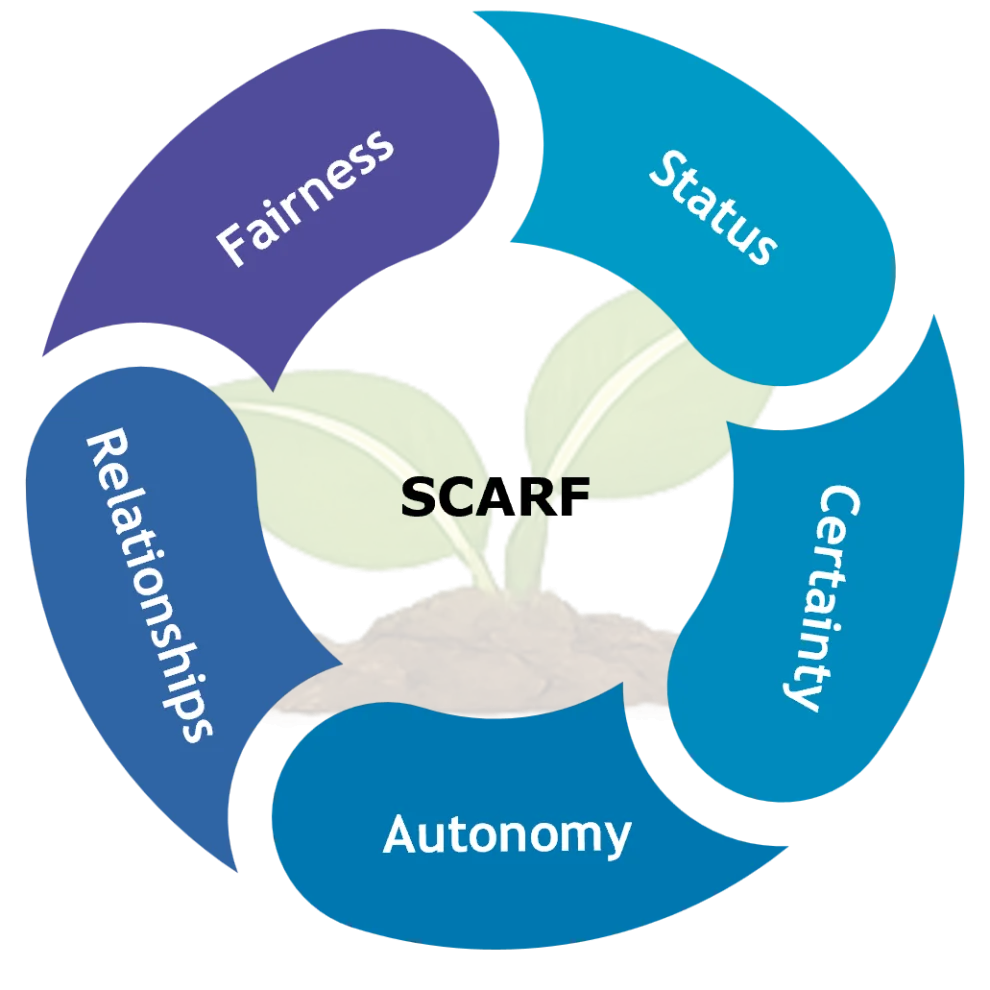
When these needs are supported, people are more likely to move towards engagement. When they are threatened, people can move towards defensiveness, withdrawal and resistance.
Think about how easily these threats can be triggered during an ordinary working day. A person’s contribution is ignored during a meeting, threatening status. A change is announced without explaining what happens next, reducing certainty. An experienced employee suddenly has every decision checked, limiting autonomy. Someone repeatedly feels excluded from conversations, affecting relatedness. Two people make the same mistake but are treated differently, challenging fairness.
The leader may never have intended to create a threat, but the brain does not respond to intention; it responds to experience.
In my workshops, I describe this as the difference between weak and strong soil. Weak soil can trigger SCARF threats, while strong soil encourages reward responses that can show up as greater initiative, collaboration, problem-solving, ownership and energy.
The goal isn’t to make sure nobody ever feels challenged or uncomfortable. That’s unrealistic. It is about becoming more aware of how everyday leadership behaviour affects people and intentionally creating conditions that encourage them to move towards engagement rather than away from it.
5 practical tips for leaders
- Status: Recognise people’s contributions and make sure their voices are heard.
- Certainty: Communicate what you know, what you don’t know and what happens next.
- Autonomy: Be clear about outcomes and boundaries, then give people appropriate freedom to deliver.
- Relationships: Invest in relationships, trust and a genuine sense of belonging.
- Fairness: Apply expectations consistently and explain the reasoning behind important decisions.
Habit #3: Examine the soil instead of blaming the plant
Imagine planting a seed in poor soil, forgetting to water it, giving it very little sunlight and then becoming frustrated because it isn’t growing. You probably wouldn’t blame the plant. Yet we sometimes do exactly that with people. When someone stops contributing, becomes defensive, avoids responsibility or appears disengaged, our first instinct can be to ask, “What’s wrong with them?”
A more useful leadership question is: “What conditions am I creating?” I often use the metaphor of the leader as a gardener. A gardener doesn’t shout at a plant to grow. They prepare the soil, remove what restricts growth, create structure, monitor the conditions and nurture what is developing. Leadership works in much the same way. The environment we create influences trust, communication, ownership, accountability and ultimately performance.
This doesn’t mean excusing poor behaviour, lowering expectations or removing accountability. Strong soil includes both psychological safety and accountability with support. If people feel safe but there are no expectations or accountability, standards can slip. If accountability is driven by fear, people may hide mistakes, avoid difficult conversations or stop speaking up. Psychological safety without accountability can become comfort. Accountability without psychological safety can become fear. Strong leadership requires both.
Before blaming the plant, examine the soil. When leaders become curious about the conditions surrounding behaviour, they are better positioned to address the real issue, strengthen psychosocial safety and create an environment where people can contribute, take ownership and perform at their best.
5 practical tips for leaders
- Watch what happens after mistakes: Do people become curious and learn, or immediately look for someone to blame?
- Notice who isn’t speaking: Silence doesn’t always mean agreement.
- Invite disagreement: Ask, “What might we be missing?” before finalising important decisions.
- Look in the mirror first: If the same problem keeps occurring, consider how your leadership or the work environment may be contributing.
- Combine care with accountability: Address performance and behaviour directly, while maintaining dignity and respect.
Before you go…
The next time someone stays quiet in a meeting, becomes defensive, resists a change or avoids taking ownership, notice your first instinct. Is it to judge their behaviour, correct them or assume they are the problem? Instead, pause and become curious about the conditions around them. Do they have enough clarity? Do they feel trusted, valued and heard? Is there appropriate autonomy? Are expectations being applied fairly?
This doesn’t mean the behaviour shouldn’t be addressed. Psychological safety does not remove personal responsibility or accountability. But asking one more question before reaching a conclusion may reveal something important about the environment you are helping to create. This week, pay attention to the small moments: what happens when someone makes a mistake, disagrees, asks for help or raises a concern?
And perhaps ask one simple question: “What could I do differently as a leader to help you feel safer to speak up, contribute and do your best work?” Then listen carefully to the answer. Because psychosocial safety isn’t created by a policy sitting on a shelf. It is strengthened through the conditions people experience every day, and as leaders, we have enormous influence over those conditions.

#WeMakeItEasy #leadershipskills #leadership #professionaldevelopment #leadershiptraining #grouptraining #onlinetraining #leadershipcoaching
If you want to know more about leadership skills and Learning & Development Programs
... team up with us, and get PROfound Leadership on your support team!
Human-centred leadership training

➡️ Discover our practical group training programs for today’s leadership challenges.
➡️ Download the training catalogue.
AUTHOR

I'm Martin Probst, an award-winning facilitator and the founder of PROfound Leadership. By facilitating 450+ workshops, I've empowered thousands of individuals worldwide to develop essential leadership skills. My dedication have earned me numerous accolades, making me a trusted name in leadership training.
Today, I specialise in delivering practical group training for organisations, supporting mid to senior leaders to navigate human behaviour, build trust and lead with confidence and clarity. My workshops are grounded in human-centred leadership and designed to address the real challenges leaders face when working with people, performance and change.



 Trustindex verifies that the original source of the review is Google.
  Trustindex verifies that the original source of the review is Google.
  Trustindex verifies that the original source of the review is Google.
  Trustindex verifies that the original source of the review is Google.
  Trustindex verifies that the original source of the review is Google.
  Trustindex verifies that the original source of the review is Google.
  Trustindex verifies that the original source of the review is Google.
  Trustindex verifies that the original source of the review is Google.
  Trustindex verifies that the original source of the review is Google.
  Trustindex verifies that the original source of the review is Google.
 If you’re leading people or supporting leaders, join our EXCLUSIVE MAILING LIST for practical leadership insights, tools and training updates.