


When did paper become more important than purpose?
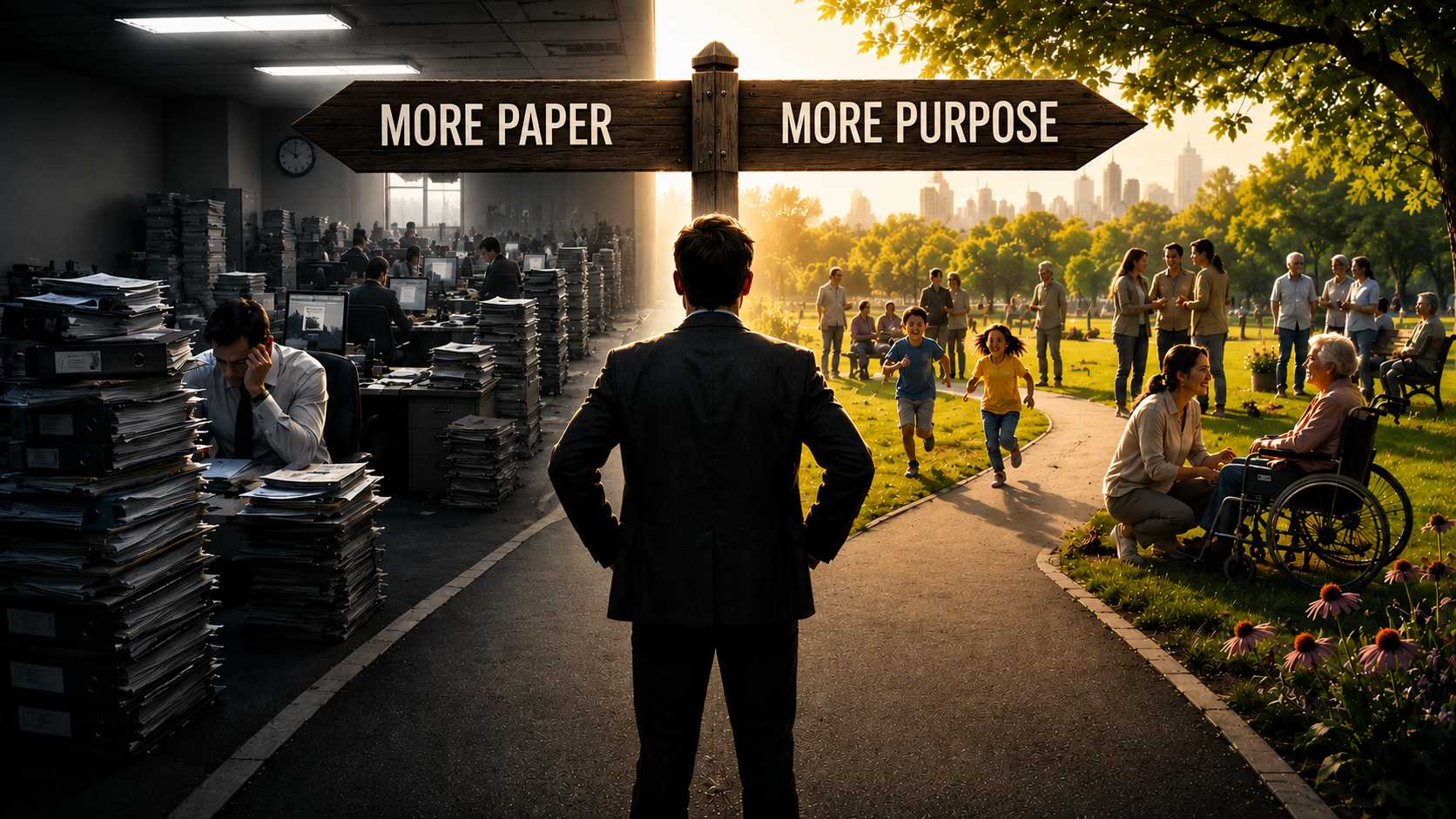
Why the best leaders remove unnecessary barriers so good people can focus on making a difference.
Somewhere along the way, we lost sight of what really matters. Because we struggle to measure the things we value most (trust, compassion, leadership, care, integrity, courage and genuine human connection) we started valuing the things we can measure instead (forms, checklists, compliance reports) on a piece of paper. And that leaves me wondering…
At what point did filling in a piece of paper saying you did the thing become more important than actually doing the thing you were supposed to do?
Think about that for a moment. If you genuinely did what you were supposed to do - but forgot to complete the paperwork - you often can’t prove that you did it. But if you completed the paperwork perfectly, even if you never really did the thing you were supposed to do, everyone assumes you did.
- The evidence becomes more important than the outcome.
- The process becomes more important than the purpose.
- The paperwork becomes more important than the people.
The word bureaucracy has an interesting origin. It comes from the French word bureau, meaning desk or office, and the Greek word kratos, meaning rule or power. Quite literally, bureaucracy means “rule by the office” or “rule by the desk.”
There is, of course, nothing inherently wrong with offices, administration or governance. Every organisation needs structure, accountability and documentation. But perhaps bureaucracy becomes “bureau-crazy” the moment the office exists to serve the paperwork instead of the people. Somewhere along the way, many of us became experts at managing the desk instead of making a difference.
Imagine this conversation between two people:
Employee: “The work isn’t finished yet.”
Manager: “Write me a status report.”
Employee: “But if I stop doing the work to write the status report, the work will take even longer.”
Manager: “Then keep me updated with weekly status reports.”
Employee: “But then I’ll soon spend more time reporting on the work than actually doing the work.”
Manager: “I still need the status reports for my manager.”
It’s funny because it’s absurd but also true in many organisations. Isn’t it?! Somewhere along the way, reporting became confused with progress. Meetings became confused with momentum. Documentation became confused with delivery.
We started measuring the appearance of productivity instead of productivity itself.
- A beautifully formatted report doesn’t solve a customer’s problem.
- A completed checklist doesn’t teach a child.
- A colour-coded dashboard doesn’t comfort a patient.
The report is not the work.
The paperwork is not the purpose.
The evidence of activity is not the same as meaningful impact.
Every time something goes wrong, our instinct seems to be the same. Create another policy, add another procedure, introduce another mandatory form, require another approval, develop another compliance process. The assumption is that more bureaucracy will somehow eliminate poor behaviour. But has it? Or have we simply made life more difficult for the overwhelming majority of people who already doing the right thing?
- The people who genuinely care.
- The teachers who want to spend more time teaching than documenting.
- The nurses who want to spend more time with patients than on the computer.
- The leaders who want to coach people instead of writing reports.
- The volunteers, carers, social workers, emergency responders and public servants who entered their profession to make a difference – not to become experts in administration.
Ironically, the people determined to exploit the system rarely lose sleep over another form.
Those willing to ignore one rule are unlikely to be stopped by rule number 427. Meanwhile, the honest, committed and conscientious people faithfully complete every new requirement, every additional form and every mandatory process, carrying an ever-growing administrative burden - often at the expense of the very work those systems were created to support.
This is the paradox of bureaucracy.
It often places the greatest burden on the people least responsible for creating the problem.
- Instead of removing the few bad offenders, we slow down everyone.
- Instead of empowering people, we control them.
- Instead of trusting professional judgement, we demand more proof.
- Instead of solving the problem, we multiply the process.
- Instead of increasing productivity, we increase administration.
- Instead of measuring meaningful outcomes, we measure completed paperwork.
We end up placing obstacles in front of the very people we should be empowering. Perhaps the real issue isn’t bureaucracy – It’s the lack of trust.
Every new form quietly says, “We don’t trust your judgement.”
Every additional approval whispers, “We don’t trust you to make the right decision.”
Every mandatory checklist assumes, “Someone will probably do the wrong thing.”
Of course, accountability, good governance and documentation matters. Healthcare needs accurate records, education needs evidence of learning, construction needs safety procedures and finance needs compliance. These systems protect people. But documentation should support good work. It should never replace good work.
The danger begins when the system forgets why it exists. When paperwork becomes the purpose instead of supporting the purpose. And when compliance becomes the goal instead of creating better outcomes.
Great leaders solve root causes; poor systems solve symptoms.
Every new procedure, every additional approval and every extra form is usually a reaction to yesterday’s failure. Individually, each change appears reasonable. Collectively, they create something no one intended - a system where good people spend more time proving they’re working than actually creating value.
Surely there is a better way.
- What if we invested as much energy into identifying and dealing with genuine offenders as we do into creating new rules for everyone else?
- What if we trusted professionals more and unnecessary processes less?
- What if we removed friction instead of adding it?
- What if we measured outcomes before outputs… impact before paperwork… and purpose before procedure.
The opposite of bureaucracy isn’t chaos.
The opposite of bureaucracy is trust supported by accountability. Great leadership doesn’t remove responsibility. It removes unnecessary barriers so responsible people can do their best work.
Because:
- We cannot regulate our way to excellence.
- We cannot legislate our way to trust.
- We cannot document our way to meaningful work.
Excellence has always been - and always will be - a human endeavour. At the end of the day:
- No customer remembers your completed checklist.
- No student remembers your perfectly filed documentation.
- No patient feels cared for because another report was submitted.
- No employee is inspired by a compliance dashboard.
People remember:
- Whether you helped.
- Whether you listened.
- Whether you cared.
- Whether you provided value.
- Whether you made a difference.
Perhaps that’s the choice every leader and every organisation face. Not simply whether to create another policy or another process… but something far more fundamental.
Will we spend our time serving the desk… or serving the people?
What are your thoughts? Please share your thoughts with us.
#WeMakeItEasy #leadershipskills #leadership #professionaldevelopment #leadershiptraining #grouptraining #onlinetraining #leadershipcoaching
If you want to know more about leadership skills and Learning & Development Programs
... team up with us, and get PROfound Leadership on your support team!
Human-centred leadership training

➡️ Discover our practical group training programs for today’s leadership challenges.
➡️ Download the training catalogue.
AUTHOR

I'm Martin Probst, an award-winning facilitator and the founder of PROfound Leadership. By facilitating 450+ workshops, I've empowered thousands of individuals worldwide to develop essential leadership skills. My dedication have earned me numerous accolades, making me a trusted name in leadership training.
Today, I specialise in delivering practical group training for organisations, supporting mid to senior leaders to navigate human behaviour, build trust and lead with confidence and clarity. My workshops are grounded in human-centred leadership and designed to address the real challenges leaders face when working with people, performance and change.




If you’re leading people or supporting leaders, join our EXCLUSIVE MAILING LIST for practical leadership insights, tools and training updates.